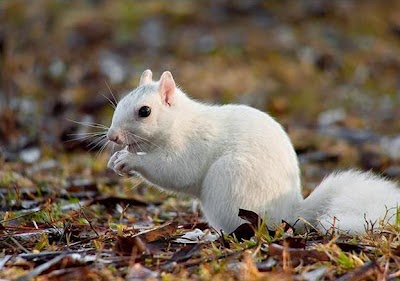
Only 10 in every one million squirrels are born with albinism, and have a very short life expectancy because they are easily seen by both predators and prey due to their obvious lack of camouflage.
What we normally think of when we think of squirrels are tree dwelling gray or reddish mammals. Rarely do we imagine their cousins, the ground squirrels (Prairie dogs) or marmots, even though they are in the same family. Nor do we think of squirrels as white! But, there are many places that have white or albino squirrel populations.
Most squirrels are gray or red, an adaptation that allows them to blend in to the surrounding vegetation. Tree trunks are usually a dark color and the mottled gray color of the common forest squirrels. However, several towns across america have claimed to have a large population of white squirrels. How could this be if it is advantageous to blend in with the tree trunks to hide from predators?
This is a case of classic natural selection, the driving force behind evolutionary change. Evolution by definition is the changing of the genetic makeup of a population over time. The trait for being white is a genetic anomalie that is usually weeded out because they are so quickly seen by predators. But today we have a different predator: humans.
Many towns have proclaimed to be the "Home of the White Squirrels," and as a result have started trapping and removing their darker brothers and sisters. What a great example of natural selection that has quickly created a dominant squirrel population that is white.
However, there are other places around the country where white squirrels are popping up and it may not be a result of humans trapping the squirrels. Many places have white stone and white buildings of which white squirrels would be highly adapted too. This small advantage may allow white squirrel populations to spread.
Friday, November 14, 2014
Friday, October 24, 2014
Help Honey Bees Survive This Winter
Honeybees are far and away the most important pollinator in today’s agricultural landscape. They pollinate more than 400 crops worldwide, help to create about a third of the food we eat, and contribute an estimated $12 billion to our nation’s food supply.
All summer long, worker bees can be seen buzzing between flowers, collecting pollen and nectar and, in the process, pollinating vast tracts of crops (upon which we depend) and producing an abundance of honey (some of which is ferried away by beekeepers to local markets for us to enjoy). As summer draws to a close and the weather starts to cool, one of the questions I get a lot is, “What happens to bees in the winter?”
People often guess that honeybees hibernate; others presume that colonies die as cold weather approaches. Fall’s first frost does kill most members of bumblebee and yellow jacket colonies, leaving lonesome queens to establish new nests each spring.
But honeybees are different.
They’ve evolved a strategy for winter survival that is unique, one that relies heavily on frenzied visitation to flowers throughout the summer and a Herculean group effort in the months beyond. Believe it or not, their success in this endeavor depends on choices that you make for your yard and garden.
Honeybees need their calorie-rich, carbohydrate-loaded honey to keep them alive during the winter; it’s the perfect furnace oil for colonies. Worker bees eat this liquid gold and use the energy it provides to fuel rapid contraction of their wing muscles. Pumping these muscles without flying produces heat in the same way that shivering helps us to warm our own bodies.
As temperatures drop, honeybees cluster together within their hive to share the warmth that their honeybees to keep the inside of their home virtually tropical while the rest of the natural world remains frozen beyond the hive’s walls.
“shivering” generates (picture a ball of bees a foot in diameter and sliced through by sheets of honeycomb). At the core of this cluster, worker bees keep themselves and their queen at a temperature that is only a few degrees lower than that of a healthy human. The cluster’s outer layer consists of tightly packed, slightly cooler workers that insulate the core as effectively as bird feathers or mammalian fur—don’t worry, everyone gets to rotate. This remarkable group behavior allows
Here’s where we come in. Honeybees in temperate climates have only a limited window—about 60 days in total—to stockpile the food reserves that they will live off for the rest of the year. This means that we need to do everything we can to create an environment that lets bees succeed as pollinators when the going is good. Here are three ways you can help bees survive winter:
• Plant late bloomers. When it comes to enhancing your garden’s fall bloom, consider adding late-flowering plants like goldenrod and asters that are critical to a colony’s final push to bring home food for the winter.
• Avoid systemic pesticides. Certain pesticides have toxins that invade all plant tissues (instead of just living on the plants’ surface), and bees bring these chemicals to their nests when they collect nectar and pollen. A group of chemicals called nitroguanidine/neonicotinoids has been shown to contribute to colony collapse disorder.
• Encourage early-spring blooms. Spring brings welcome relief for honeybees with a chance to restock dwindling floral supplies. Flowering trees—willows, maples, and the like—provide some of the earliest opportunities for bees to forage, so try to encourage their toxin-free growth when you can.
Friday, October 3, 2014
How to Store Apples for Winter
Interested in storing a bushel of apples to enjoy over the cold winter months? Once you learn a few storage tricks, it's easy to do.
2. Inspect all apples for bruises, cuts and soft spots. Only perfect fruit is suitable for storage.
3. Sort the apples by size: small, medium and large. Since large apples don't store as well, this will make it easy to ensure that they get eaten first.
4. Place the sorted apples in perforated plastic bags or in boxes lined with perforated plastic (to allow for air circulation).
5.Store in a cool basement, garage, fruit cellar or refrigerator. The ideal storage temperature is 30-32°F with 90% humidity. Apples are likely to suffer freeze damage if the temperature dips below 30° and will ripen quickly, if the temperature rises above 40°, so do your best to match these conditions.
Check regularly for signs of spoilage, and remove any damaged fruit.
Tips:
1. Pick apples when they are ripe. Over or under-ripened fruit will not store well.
2. Store apples as soon after picking as possible.
3. Avoid storing your apples near onion or potatoes. They'll readily absorb the flavor of other foods.
4. Don't mix apple varieties. Different varieties ripen at different rates.
5. Expect your apples to last up to five months in storage (depending on variety and storage conditions).
Tuesday, September 2, 2014
Tips For Growing Cucumbers
Cucumbers are great for pickling, tossing in salads, or eating straight off the vine.
There are two types of cucumbers: slicing and pickling. Each type comes in several different varieties. The slicing types are long and usually grow to about 6 or 8 inches in length while the pickling types are shorter, reaching around 3 to 4 inches once mature.
There are now many bush or compact varieties of cucumbers available that are ideal for growing in limited space.
Cucumbers can be started indoors in peat pots or small flats and transplanted to the garden a couple weeks thereafter but only when all danger of frost has passed. Before you move them to the garden, however, harden the cucumber plants off in a protected location to lessen any stress that may occur during transplanting. During cool periods, cucumbers can be covered with plant protectors as well.
Cucumbers like warm, humid weather; loose, organic soil; and plenty of sunlight. They grow well in most regions of the United States and do especially well in the South.
When planting cucumbers, choose a site that has adequate drainage and fertile soil. Good soil will have plenty of organic matter, such as compost. Adding compost to the soil will help get your cucumbers off to a good start, and applying an organic fertilizer, such as manure, will help give the plants nutrients during growth. When you begin preparing the soil, remove any rocks, sticks or other debris and then mix ample amounts of organic matter and fertilizer into the soil.
Cucumbers may be planted in hills or rows about 1 inch deep and thinned as needed. Since cucumbers are a vine crop, they usually require a lot of space. In large gardens, cucumber vines may spread throughout rows; within smaller gardens, cucumbers may be trained for climbing on a fence or trellis. Training cucumbers on a fence or trellis will reduce space and lift the fruit off the soil. This method also can provide your garden with a neater appearance. The bush or compact varieties are quite suitable for growing in small spaces or even in containers.
Friday, July 25, 2014
Symptoms of a Sick Goat
In order to be able to recognize when a goat is sick, the owner must closely observe their herd when they are healthy. The average healthy goat is alert and curious. They show interest in food and chew their cud after feeding. Their eyes are bright and clear and their nose is dry. Their coat is shiny and clean and in good weather their tail is up. Their droppings are firm and pelleted and their gait is energetic and steady. They will have a temperature between 101.5 and 103.5, keeping the outside weather conditions in mind.
Through daily observation the goat owner will learn what is normal for the individuals in their herd and will be able to quickly spot a goat that just isn’t acting right, one that may be sick. Early assessment and action greatly increases the chances of a successful outcome to treatment.
Some warning signs of a goat that may be sick or need medical attention are:
A goat that separates itself from the rest of the herd.
Standing with its head and tail down, with a hunched back.
Trembling, muscle twitching or head shaking.
A goat that is anxious or weak, listless or reluctant to move.
Poor appetite, won't eat or won't drink.
Change in consistancy or color of feces, scouring (diarrhea) or tapeworm segments.
Strains to urinate, unable to urinate, or blood in the urine.
Fever (above 103.5) or subnormal temperature. (below 101.5)
Moans or cries.
Grinding teeth, signs of pain.
Bloated, kicking or biting at stomach.
Enlarged knees or recuring abscesses.
Rapid, shallow breathing.
Chronic cough or sweet smell to breath.
Cloudy or green nasal discharge.
Cloudy, watery, closed eyes or a discharge from them.
Dull, scruffy coat, sores, scabs or other skin problems.
Excessive rubbing, scratching or biting at lower legs.
Soft swelling under face (bottlejaw), white gums and inner eyelids.
Abnormal color or consistency of milk.
Hot, lumpy or hard udder.
Limping, tender "walking on eggshells" gait or a bad, distinctive odor to hooves.
Unsteady, drunken like gait, circling or stiff sawhorse like stance.
Unable to stand, lies on side making paddling movements.
Unexplained weight loss.
Although goats are typically hardy animals, they can still be susceptible to parasites, illness and diseases. A preventative disease program should be discussed with your goat knowledgeable veterinarian.
Monday, June 30, 2014
The Importance of Quarantining New Goats
If you’re adding goats to an existing herd, you need to quarantine any new goats you purchase for at least 30 days. This means that you need an area with adequate shelter that completely separates your herd from the new goats. Quarantine protects the other goats from any unknown or undisclosed health problems that the new goats might have.
During the goats’ quarantine time, do the following:
Have them tested for CAEV or any other diseases you want to test for, unless the seller has provided you with documentation that the goat has been tested and had negative results.
Observe the goats for signs of any disease, such as soremouth lesions or abscesses.
Watch how the goats adjust to your feeding and management program.
Do a fecal analysis and deworm if necessary. If you’re unable to do a fecal analysis, routinely deworm all goats in quarantine
One particular symptom you should keep an eye out for is shipping fever. Blood tests show that a goat needs about three hours after being transported to stop having a physical stress response, but the move's effect on the goat's immune system can last longer. This immune response can, at worst, lead to shipping fever.
Shipping fever can cause pneumonia and sometimes diarrhea. Signs to look for include temperature of over 103.5° Fahrenheit, nasal discharge, coughing, rapid breathing, or rattling in the chest. Contact a veterinarian if your new goat has any of these signs.
Thursday, June 12, 2014
How to Control Insects in Your Goats' Living Space
If you're new to raising goats, it may surprise you that flies, mosquitoes, and other bugs are part of raising livestock. But you do have some options for controlling these critters. The cheapest way to minimize pests is to keep the barn or goat shed dry and remove wet bedding weekly during warm or hot weather. Pay special attention to the areas around water buckets, where the flies are more likely to breed.
You can also build a bat house for the outside of the barn or on a nearby tree. Bats eat mosquitoes and other insects, and so having them around is beneficial to a farm. The only disadvantage to having bats is that they carry rabies, which a curious goat can get from inspecting a crazy-acting bat.
To discourage mosquitoes, eliminate standing water where they can breed. If you have water that continues to build up, just pour some vegetable oil on the top to stop the mosquitoes from breeding. Or you can buy a product called Mosquito Free Water from livestock supply companies; it's safe and can be sprayed on standing water.
Some people use insecticides to control flies and other pests, and you can find many of them on the market for just this purpose. But remember: the chemicals are poison and can harm you and your goats. You probably don't want insecticides in your milk or meat. Here are some non-toxic methods for controlling flies:
Fly parasites: You can buy these tiny wasps, which feed on fly larvae, from biological pest control companies and some livestock supply catalogs. You get them in regular shipments through the mail and put them out through the summer near wet areas, where flies are more likely to hatch.
Fly strips: These are inexpensive and amazingly effective. You unwind these sticky strips and hang them with tacks around the barn. When the flies land on them they get stuck. Mr. Sticky is the most effective brand.
Mr. Sticky mini roll: This product is superior to fly strips because the roll lies horizontally rather than vertically, and so flies are more likely to land on it. The mini kit is perfect for a small barn. It is an 81-foot reel that you attach to the walls across a stall and roll up as it fills with flies. You can also buy a 1,000-foot roll.
Fly trap: You can find various fly traps on the market. One is a plastic bell-shaped trap that you fill with stinky bait and hang from the ceiling. Flies are attracted to the smell, crawl in, and then can't get out. These smell bad, so you need to place them where you won't accidentally walk into one.
Citronella fly spray: Citronella spray is made for horses, but you can spray it directly on goats when they are being bothered by deer flies or horse flies that are particularly aggressive.
Subscribe to:
Posts (Atom)


