Wednesday, May 21, 2014

How to Give Your Goat an Injection

You can have a vet visit or take your goats to a clinic to receive vaccinations or other injections, and many goat owners do this. But to save the money, you can do it yourself. Giving injections is easy after you get over any fear you might have.

It can help to have an experienced person demonstrate the technique before you try it. You can also practice by injecting into an orange — just remember to dispose of your practice needles and syringes. You can get needles and syringes at a feed store, veterinary office, or livestock supply catalog.

Anaphylaxis is a severe, sudden allergic reaction. The faster it occurs, the more severe it is. If a goat unexpectedly collapses or goes into shock after an injection, administer epinephrine immediately. The dose is 0.5–1.0 cc per 100 pounds.

The two most common types of injections are subcutaneous (SQ), which is just under the skin, and intramuscular (IM), which goes into the muscle. Read the instructions that come with the medication you're using to determine what type of injection to give. Most injections that can be given IM also can be given SQ; consult with your veterinarian regarding which injections you need to give IM. Giving subcutaneous injections is a bit easier because you don't have to worry about hitting a blood vessel or vein.

When you're ready to give injections yourself, gather your supplies and bring your goat into an area away from the other goats. Have someone hold the goat and find the site where you will give the injection.

Never use the rear leg as an injection site because you can hit a nerve and make your goat lame.


The best places to give injections are the sides of the neck and "armpit" area just behind the front leg.

Gather your supplies:

Medication

Disposable needle and syringe

Alcohol and cotton balls or other wipes

Container for sharps (used needles), which you can purchase at a drug store

Before giving the injection, wipe the top of the medicine vial with alcohol to ensure that it's sterile. Then insert the needle into the bottle and withdraw the required dose of medication. Withdraw the needle and tap the syringe and push the injector slightly to push out any bubbles.

To give an SQ injection:

Lift the skin into a tent.

Insert the needle under the skin into the tent, toward the body.

Make sure that the needle isn't in the skin or muscle, or through the other side of the tent.

Inject the medication and remove the needle.

Discard the needle and syringe into your sharps container.

To give an IM injection:

Insert the needle into the muscle, being careful not to hit bone.

Withdraw the plunger slightly to make sure that you have not hit a vein or vessel.

If you see blood in the syringe, pull out the needle and start over.

Depress the plunger slowly, and then withdraw the needle.

Rub the injection area gently but firmly to distribute the medication.

Discard the needle and syringe into your sharps container.

Never use the same needle or syringe for different medications or on different goats. Mixing medications can make them less effective or cause an unexpected chemical reaction; sharing needles can spread diseases from one goat to another.

Friday, April 25, 2014

5 Incredibly Intelligent Animals


Octopuses are considered the most intelligent of all invertebrates, and are even smarter than most other species on the planet. They have both short and long-term memory, they can navigate mazes and escape from aquariums, and they have even been known to sneak aboard fishing boats, pry open holds and gorge on captured crabs. It’s very tough to keep octopuses as pets due to their problem-solving skills and their ability to squeeze through openings no bigger than their eyeballs.


Humans have been domesticating and training elephants for the last four thousand years. Their intelligence, coupled with their strength, has been put to use in construction, war, and under the big top as entertainment. The extremely sad fact is that if elephant poaching continues at its current rate, African elephants could be extinct in less than fifteen years. 


A member of the highly intelligent bird family known as corvids, crows have often proven themselves just as clever as chimps and gorillas. Not only are their brains about the same size as some primates, but they share many behavioural similarities: using tools to get food, retaining memories, and anticipating future events to help them solve problems.


We are quick to reward the dog when he rolls over on command, yet we’ll cringe at the sight of a pig rolling in filth. But pigs are, in fact, the smarter of the two species. Pigs can be taught the meaning of certain words and phrases, and, after years without hearing them, will still remember what those meanings are. Mothers sing to their young while they’re nursing, pigs learn from the mistakes of other pigs, and they can play videogames too complex for 3-year old children. 


Before Jane Goodall discovered that chimpanzees use sticks to dig and fish out delicious termites, it was believed that only humans wore the tool belt in the animal kingdom. But not only do chimpanzees use tools for food, they can also fashion weapons for hunting.


Chimpanzees live in highly organized hierarchal societies, can appreciate a beautiful sunset, will mourn the death of a loved one, and can not only learn sign language but pass it along to others.

Wednesday, April 2, 2014

10 REASONS WHY YOU SHOULD EAT RABBIT MEAT!

Back in the 1940s and 1950s rabbit meat was as common for dinner as chicken is today. It is the meat they got many people and their children through the lean times of the Depression. They lost their popularity after Big AGRA, who wanted to get maximum profits with the cheapest bottom line using the government endorse chemicals and handouts. Because of this rabbits didn’t make sense. So why even eat rabbit meat now? Below you will find a few reasons why you should consider adding rabbit meat to your diet. Raise some rabbits in your lots, yards, or pastures. Become closer to your food supply know what you eat!


1. It is one of the best white meats available on the market today.

2. The meat has a high percentage of easily digestible protein.

3. It contains the least amount of fat among all the other available meets.

4. Rabbit meat contains less calorie value than other meats.

5. Rabbit meat is almost cholesterol free and therefore heart patient friendly.

6. The sodium content of rabbit meat is comparatively less than other meats.

7. The calcium and phosphorus contents of this meat or more than any other meats.

8. The ratio of me to bone is high meaning there is more edible meat on the carcass than even a chicken.

9. Rabbit meat with the many health benefits does not have a strong flavor and is comparable to chicken but not identical.

10. Rabbits are one of the most productive domestic livestock animal there is. Rabbits can produce 6 pounds of meat on the same feed and water as the cow will produce 1 pound of meat on the same feed and water.

So as you can see there are many health benefits to eating rabbit meat. It is healthy for you and cheap to produce. Why not try to incorporate some rabbit meat into your diet today! Try it you’ll like it! Use rabbit as a replacment for chicken in any chicken recipe.

Monday, March 10, 2014

Top 11 Reasons to Raise Rabbits

People from all around the world have chosen to raise domestic rabbits for a multitude of different reasons. Here is a list of 11 reasons why you should consider raising rabbits…


1. Rabbits are Low Maintenance- One of the best things that I like about rabbits is the fact that they are relatively low maintenance animals.

2. Rabbits are Quiet- Yes I said it, rabbits are actually one of the quietest types of animals on the planet

3. Economical- Breeding rabbits can indeed be economical, even extremely profitable if you put forth the time and dedication

4. Rabbits can indeed “Multiply like Rabbits”- Although struggling breeders will sometimes tell you different, rabbits can indeed multiple like rabbits

5. Rabbit Meat is Healthy- Even if you never plan on eating rabbit meat yourself, if you breed rabbits you can rest assured that there is a market for rabbit meat in case you need to sell off stock or culls

6. Rabbit Manure is Valuable- Believe me when I say that rabbit manure works great as a fertilizer! Apply it to your garden and watch your plants bloom or bag it up and earn a little spending money off of it.

7. Rabbits Can Make Great Pets- Rabbits can indeed make great pets- just make sure you choose the right breed or you might be disappointed!

8. Self Fulfilling- When you successfully breed rabbits you will most likely begin to feel self-fulfillment in your accomplishment (There is something about watching your rabbits grow that gives you a good feeling inside)

9. Chance at Showing- If you plan on showing rabbits, you will most likely have a great time and make some new friends!

10. Great Learning Experience- It would literally take an entire book to tell you about everything I have learned from raising rabbits!

11. Raising Rabbits is Fun- Most importantly raising rabbits can be a fun enjoyable experience as long as you do your research ahead of time.

Monday, February 17, 2014

Saving the Spanish donkey

In popular culture the humble donkey is as emblematic of Spain as a bull or a flamenco dancer.  From the sublime little fat Sancho Panza riding alongside Don Quijote, to the ridiculous straw donkeys sold in tourist shops, this beast of burden has become folkloric in its symbolisation of all that is Spanish. So it is shocking to learn that of the six species native to Spain every single one is in danger of extinction. The Córdoban is the largest and there are less than 100 pure bred ones remaining.

The working donkey or mule (the offspring of a mare and donkey) is an increasingly rare sight in Spain, although it is still seen in parts of rural Andalucía and Galicia. At the end of the civil war (1939) there were an estimated 1,250,000 donkeys in the country but the figure is now down to just 65,000.


Intelligent, cautious, friendly, playful, and eager to learn, they have been used since before recorded history to carry loads, pull carts and take riders. Donkeys have a reputation for stubbornness but studies now show that this is in fact a highly developed sense of self preservation.  It is almost impossible to force a donkey into doing something that is against its best interests.  A horse, for example will walk along a path where the footing is unsafe; a donkey will not.  Though slower than horses they live longer and are cheaper to keep.  Their great endurance and agility has made them popular work animals and in many developing countries they are still of vital economic importance.

Donkeys were among the pack animals used to carry silk from the Pacific Ocean to the Mediterranean along the 'Silk Road' in return for trade goods. The overland route was approximately 6,400 kilometres and the journey lasted several years. Because of the length of the expedition, no single animal completed the entire journey and mixing of breeds occurred as unplanned matings occurred en-route. The journey ended in Greece, Italy, the Middle East and Alexandria in Egypt. The Greeks were delighted with the donkeys, which were found to be ideal animals for working on the narrow paths between the vines.


Their use in vineyards spread through the Mediterranean countries to Spain where they quickly also became the principle means of transport for people and goods. Their surefootedness and fortitude made them the ideal animal for Spain’s inhospitable terrain.  From the departure of the Romans to the turn of the last century few roads were built in Spain and even the main routes were in a poor state.  Donkey trains over precarious, muddy and rocky tracks were the mainstay of the avenues between cities, towns and villages.  They laboured on building sites, were taken to battlefields to carry supplies and drag guns for the army, they turned mills and having worked the land they carried the produce to market.

But apart from some rural areas in Spain this ubiquitous symbol of toil has all but disappeared and its decline has been caused mainly by the mechanisation of agriculture and the gradual abandonment of the rural way of life.   Young people are seduced by towns and cities and the way of life that continued right up until the 1960s has rapidly waned.

Although to northern Europeans the donkey is looked upon as not only cuddly but worthy of our respect, the Spanish are not nearly so sentimental.  The donkey has traditionally been an object of scorn in folklore and there are countless Spanish phrases that define the burro as a slow, stupid and stubborn animal. Modern Spanish dictionaries give a second definition of burro as: ‘idiot’, ‘oaf’, ‘stupid’. Despite the fact that the cross on the donkey’s back is supposed to be a holy mark in recognition of a donkey carrying Jesus into Nazareth you get the feeling that the beast hasn’t quite been forgiven by fiercely Catholic Spain for delivering the Saviour to his fate.

Where donkeys are still used as working animals their treatment can give cause for concern and the older animals are frequently turned out to fend for themselves. Over the last decade, sanctuaries have been opened in Spain to preserve and rescue breeds that are in danger of extinction.

As you might expect where animals are concerned, the British are keen to help, with popular registered charity the Donkey Sanctuary opening its first European sanctuary in Spain, near Malaga. El Refugio del Burrito aims to provide permanent refuge to any donkey or mule in need of sanctuary. The replacement of traditional working donkeys with machinery resulted in the abandonment of many donkeys that had already been neglected.  Latest figures suggest there are around 140,000 donkeys and mules in Spain.  Run by Director of European Operations, Paul Svendsen, the son of Dr Elisabeth Svendsen who founded the Donkey Sanctuary in 1969 who has been encouraged by the good response from the Spanish authorities and believes it is the right time to start working in Spain.

"I believe animal welfare in Spain is beginning to improve. We saw legislation introduced in 2003 enforcing the protection of animals used during festivals in the region of Extremadura. With El Refugio Del Burrito registered as a Spanish association we can now lobby for further improvements in legislation for donkeys and mules throughout the country.”

The Sanctuary’s most famous rescue was ‘Blackie’ a donkey that was earmarked to take part in the "Pero Palo" Fiesta  in Extremadura’s Villa Nueva de la Vera on Shrove Tuesday when the animal is jostled and dragged through the village by a partially drunken crowd. Fed alcohol and sat on by the heaviest man in the village the animal usually collapses and dies. Blackie was taken to the Sanctuary in Devon to end her years and Extremadura banned the fiesta.

El Refugio is particularly keen to preserve the Andalucian Giant Donkey, one of the most ancient breeds of European donkeys with Jacks (males) reaching as high as 16 hands (1.6m), which is as tall as a large horse. These are pure breed donkeys, not mules but a recent study suggests that there are as few as 120 of these amazing giants left making them a seriously endangered indigenous species. Traditionally these giant donkeys have always been found in Southern Spain, where formerly they were used extensively by the military, to cross breed with horses, producing a very strong mule, well suited to carrying munitions and provisions.  They have been almost totally replaced in both these areas of work by mechanisation.


Because of this mechanisation, these donkeys become a liability and together with many other donkeys of pure and cross breeds, are often collected together by dealers and shipped, under often quite horrendous conditions, with few stops and little water and food, to other European countries, where they are slaughtered and may be used as a prized ingredient in some salamis.

They were also employed in the cork forests, olive and citrus groves, and carrying out almost any heavy work, including ploughing, pulling carts and for riding

In 1989 Pascual Rovira set up the ‘Asociación para la Defensa del Borrico’ (ADEBO) in the little town of Rute, in the heart of the lovely Parque de la Sierra sub-Bética His efforts to publicise the plight of the donkey have already gone a long way towards putting Rute on the map. Pascual has donated donkeys as gifts to the Spanish royal family and even to Bill Clinton to raise awareness about the animals. More than a hundred donkeys have been rescued from all over Spain and there are representatives of most of the national breeds.

Thursday, January 23, 2014

Bee Hummingbird


The Bee Hummingbird (Mellisuga helenae) is the #smallest #bird and the smallest #warm-blooded vertebrate. It is also known as #Cuban #bee as it is found mostly in Cuba. It measures 5.7cm in length and 1.8g in weight. 


The Bee Hummingbird is said to eat half its total body mass and drink eight times its total body mass each day. We cannot see its wings while flying as it flaps its wings 90 times per second. 


The heartbeat of this #bird is 1,260 times. The size of its nest measures 2cm wide and 3cm deep. Its #eggs are smaller than coffee grounds.

Monday, December 23, 2013

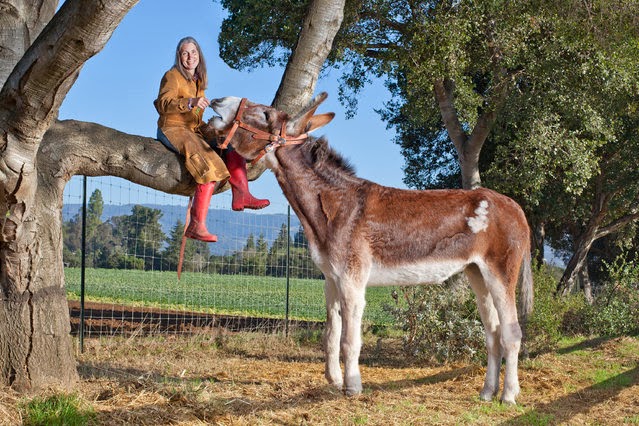
The tallest donkey !


The tallest #donkey living is Oklahoma Sam, a four-year-old American Mammoth Jackstock.


Sam measured 15.3 hands (155.45 cm; 5 ft 1 in) tall and is owned by Linda Davis of Watsonville, California, USA.


  Guinness World Records also recognized the world record for the Largest collection of #donkeys, set by Delores DeJohn (USA), who has 690 donkey-related items.