
Friday, December 19, 2014

Tuesday, December 16, 2014
.jpg)
Thursday, November 27, 2014
Cashmere Goats and their Fiber

Cashmere goats can serve a multitude of purposes:
They produce 3-4 ounces of fine, soft fiber a year which can be processed into wool for knitted garments
They are useful for clearing fence lines and undesirable weeds
Their pelts can be used for rugs and seat covers
Their meat is low in cholesterol
Their history:
Cashmere goats originally came from the Himalayas and migrated with Chinese herders to Mongolia, Tibet and Northern provinces of China in the 10th and 12th centuries. With the development of the Asian empire, cashmere slowly began to enter the trade routes in the West. In the 13th century Marco Polo brought cashmere to Italy where it became the fiber of choice among the aristocratic elite.
Processing the fiber:
Our cashmere goats have a fine, downy undercoat which protects them from the cold winters, Each spring the fleeces are removed by either combing or shearing. A typical adult goat produces 3-4 oz. of pure down, enough for about 1/3 of a sweater. The finest cashmere is harvested when the goat is 2-4 years old and after the age of five, the goat’s value is based on its ability to produce offspring. Once the cashmere is combed off or sheared, the dirt, grass and other non-fiber contaminants must be removed. The fiber is then sorted by fineness and length. Coarse hairs are removed leaving behind the medium and long fine hairs. The shortest cashmere hairs are extremely soft, but because they are so short they will pill if they are woven into clothing. The fleece is then sorted by color which can be white, off white, tan, brown or grey. The fleece is then washed, dried and spun into skeins of yarn or left as raw roving. It takes approximately a year’s worth of wool from three to four goats in order to make a woman’s single ply cashmere sweater. Cashmere is eight times warmer than sheep’s wool and 33% lighter. Cashmere fiber has a crimp or curl that sheep’s wool does not have. This extra crimp holds pockets of warm air close to the body. It is the softest animal fiber readily available on the market measureable by its low micron count. The micron count is the measure of the diameter of the fiber and the lower the number, the softer the fiber. The finest cashmere has a micron count of 16 or less.
Un-dyed cashmere ranges in color from a snowy white to a chocolate brown with variations of brownish-grey. White is the most valuable because it can readily accept dye. However, the more dye that is used, the coarser it feels. The naturally darker cashmere fibers will be dyed when trying to achieve a black, dark navy, charcoal or brown. The natural white cashmere fibers will be bleached white and dyed into pastel colors.
Most cashmere sweaters have a label that says Dry Clean Only, but this is to remove liability should you incorrectly wash your cashmere and ruin it. The quality of a cashmere item can actually improve if you wash it properly in cold water by hand or machine and dry without any heat. It is more expensive to hand knit a cashmere sweater than to buy one because the hand knitting yarn is much thicker than commercial yarn. The cashmere sweater you buy in a store uses a much thinner commercial yarn which cannot be hand knit. The world produces 9,000-10,000 tons of cashmere each year.
50-60% comes from China (including Tibet and Inner Mongolia)
20-30% comes from Mongolia
10-20% comes from Iran and Afghanistan
Friday, November 14, 2014
Albino Squirrel
Only 10 in every one million squirrels are born with albinism, and have a very short life expectancy because they are easily seen by both predators and prey due to their obvious lack of camouflage.
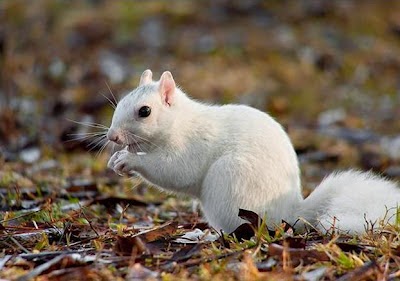 What we normally think of when we think of squirrels are tree dwelling gray or reddish mammals. Rarely do we imagine their cousins, the ground squirrels (Prairie dogs) or marmots, even though they are in the same family. Nor do we think of squirrels as white! But, there are many places that have white or albino squirrel populations.
Most squirrels are gray or red, an adaptation that allows them to blend in to the surrounding vegetation. Tree trunks are usually a dark color and the mottled gray color of the common forest squirrels. However, several towns across america have claimed to have a large population of white squirrels. How could this be if it is advantageous to blend in with the tree trunks to hide from predators?
This is a case of classic natural selection, the driving force behind evolutionary change. Evolution by definition is the changing of the genetic makeup of a population over time. The trait for being white is a genetic anomalie that is usually weeded out because they are so quickly seen by predators. But today we have a different predator: humans.
Many towns have proclaimed to be the "Home of the White Squirrels," and as a result have started trapping and removing their darker brothers and sisters. What a great example of natural selection that has quickly created a dominant squirrel population that is white.
However, there are other places around the country where white squirrels are popping up and it may not be a result of humans trapping the squirrels. Many places have white stone and white buildings of which white squirrels would be highly adapted too. This small advantage may allow white squirrel populations to spread.
Most squirrels are gray or red, an adaptation that allows them to blend in to the surrounding vegetation. Tree trunks are usually a dark color and the mottled gray color of the common forest squirrels. However, several towns across america have claimed to have a large population of white squirrels. How could this be if it is advantageous to blend in with the tree trunks to hide from predators?
This is a case of classic natural selection, the driving force behind evolutionary change. Evolution by definition is the changing of the genetic makeup of a population over time. The trait for being white is a genetic anomalie that is usually weeded out because they are so quickly seen by predators. But today we have a different predator: humans.
Many towns have proclaimed to be the "Home of the White Squirrels," and as a result have started trapping and removing their darker brothers and sisters. What a great example of natural selection that has quickly created a dominant squirrel population that is white.
However, there are other places around the country where white squirrels are popping up and it may not be a result of humans trapping the squirrels. Many places have white stone and white buildings of which white squirrels would be highly adapted too. This small advantage may allow white squirrel populations to spread.
Friday, October 24, 2014
Help Honey Bees Survive This Winter
Honeybees are far and away the most important pollinator in today’s agricultural landscape. They pollinate more than 400 crops worldwide, help to create about a third of the food we eat, and contribute an estimated $12 billion to our nation’s food supply.
All summer long, worker bees can be seen buzzing between flowers, collecting pollen and nectar and, in the process, pollinating vast tracts of crops (upon which we depend) and producing an abundance of honey (some of which is ferried away by beekeepers to local markets for us to enjoy). As summer draws to a close and the weather starts to cool, one of the questions I get a lot is, “What happens to bees in the winter?”

But honeybees are different.
They’ve evolved a strategy for winter survival that is unique, one that relies heavily on frenzied visitation to flowers throughout the summer and a Herculean group effort in the months beyond. Believe it or not, their success in this endeavor depends on choices that you make for your yard and garden.
Honeybees need their calorie-rich, carbohydrate-loaded honey to keep them alive during the winter; it’s the perfect furnace oil for colonies. Worker bees eat this liquid gold and use the energy it provides to fuel rapid contraction of their wing muscles. Pumping these muscles without flying produces heat in the same way that shivering helps us to warm our own bodies.
As temperatures drop, honeybees cluster together within their hive to share the warmth that their honeybees to keep the inside of their home virtually tropical while the rest of the natural world remains frozen beyond the hive’s walls.

Here’s where we come in. Honeybees in temperate climates have only a limited window—about 60 days in total—to stockpile the food reserves that they will live off for the rest of the year. This means that we need to do everything we can to create an environment that lets bees succeed as pollinators when the going is good. Here are three ways you can help bees survive winter:
• Plant late bloomers. When it comes to enhancing your garden’s fall bloom, consider adding late-flowering plants like goldenrod and asters that are critical to a colony’s final push to bring home food for the winter.
• Avoid systemic pesticides. Certain pesticides have toxins that invade all plant tissues (instead of just living on the plants’ surface), and bees bring these chemicals to their nests when they collect nectar and pollen. A group of chemicals called nitroguanidine/neonicotinoids has been shown to contribute to colony collapse disorder.
• Encourage early-spring blooms. Spring brings welcome relief for honeybees with a chance to restock dwindling floral supplies. Flowering trees—willows, maples, and the like—provide some of the earliest opportunities for bees to forage, so try to encourage their toxin-free growth when you can.
Friday, October 3, 2014
How to Store Apples for Winter
Interested in storing a bushel of apples to enjoy over the cold winter months? Once you learn a few storage tricks, it's easy to do.

2. Inspect all apples for bruises, cuts and soft spots. Only perfect fruit is suitable for storage.
3. Sort the apples by size: small, medium and large. Since large apples don't store as well, this will make it easy to ensure that they get eaten first.
4. Place the sorted apples in perforated plastic bags or in boxes lined with perforated plastic (to allow for air circulation).
5.Store in a cool basement, garage, fruit cellar or refrigerator. The ideal storage temperature is 30-32°F with 90% humidity. Apples are likely to suffer freeze damage if the temperature dips below 30° and will ripen quickly, if the temperature rises above 40°, so do your best to match these conditions.
Check regularly for signs of spoilage, and remove any damaged fruit.
Tips:
1. Pick apples when they are ripe. Over or under-ripened fruit will not store well.
2. Store apples as soon after picking as possible.
3. Avoid storing your apples near onion or potatoes. They'll readily absorb the flavor of other foods.
4. Don't mix apple varieties. Different varieties ripen at different rates.
5. Expect your apples to last up to five months in storage (depending on variety and storage conditions).
Tuesday, September 2, 2014
Tips For Growing Cucumbers
Cucumbers are great for pickling, tossing in salads, or eating straight off the vine.

There are two types of cucumbers: slicing and pickling. Each type comes in several different varieties. The slicing types are long and usually grow to about 6 or 8 inches in length while the pickling types are shorter, reaching around 3 to 4 inches once mature.
There are now many bush or compact varieties of cucumbers available that are ideal for growing in limited space.
Cucumbers can be started indoors in peat pots or small flats and transplanted to the garden a couple weeks thereafter but only when all danger of frost has passed. Before you move them to the garden, however, harden the cucumber plants off in a protected location to lessen any stress that may occur during transplanting. During cool periods, cucumbers can be covered with plant protectors as well.
Cucumbers like warm, humid weather; loose, organic soil; and plenty of sunlight. They grow well in most regions of the United States and do especially well in the South.
When planting cucumbers, choose a site that has adequate drainage and fertile soil. Good soil will have plenty of organic matter, such as compost. Adding compost to the soil will help get your cucumbers off to a good start, and applying an organic fertilizer, such as manure, will help give the plants nutrients during growth. When you begin preparing the soil, remove any rocks, sticks or other debris and then mix ample amounts of organic matter and fertilizer into the soil.
Cucumbers may be planted in hills or rows about 1 inch deep and thinned as needed. Since cucumbers are a vine crop, they usually require a lot of space. In large gardens, cucumber vines may spread throughout rows; within smaller gardens, cucumbers may be trained for climbing on a fence or trellis. Training cucumbers on a fence or trellis will reduce space and lift the fruit off the soil. This method also can provide your garden with a neater appearance. The bush or compact varieties are quite suitable for growing in small spaces or even in containers.
Subscribe to:
Posts (Atom)