Monday, January 26, 2015

How to Choose Turkey Breeds

There are not nearly as many turkey breeds as there are chicken breeds, but there are still enough varieties of turkeys to warrant a decision about which breed or breeds of turkey you will raise as a small farmer or homesteader.


These are the "modern" turkey breed that are raised in factory farm settings across the United States. They maximize the conversion of feed to white breast meat in the shortest possible time. But this efficiency is not without problems. Broad-Breasted Whites can't walk or fly, are prone to disease, and can't reproduce without artificial insemination. They don't taste too great, either.


So, you might be thinking, "What about a heritage breed?" If you want to go the more natural route, which most small farmers and homesteaders do, steer clear of the Broad-Breasted Whites. There are quite a few heritage turkey breeds to choose from. These are the most popular and common of the thirteen recognized heritage turkey breeds.


Bourbon Red turkeys are noted for - yes, you guessed it - their beautiful red plumage. The "Bourbon" comes from their origin in Bourbon County, Kentucky, where they were first bred in the 1800s. They're also known for a delicious, full flavor and are considered one of the best-tasting heritage turkey breeds. Bourbon toms can get to 23 pounds and hens can reach 12 pounds.


Originally from Rhode Island (as you might surmise from the name), Narragansetts were the staple of the New England turkey scene before factory-farmed turkeys became the norm. Typical sizes are 18 pounds for hens and 30 pounds for toms.


Midget Whites are a relatively new heritage breed developed in the 1960s by researchers at the University of Massachusetts. They are a cross of Royal Palm and Broad-Breasted Whites. Although small, Midget Whites are known for their deep, delicious flavor. Toms weigh 16 to 20 pounds and hens weigh 8 to 12 pounds.

Midget Whites are calm and do well raising poults. Because the hens are small, they can become good fence-jumpers.


Developed in the 1930s, these birds are roughly the same size as the Midget Whites, but with wider breasts. They make a nice table bird but are blander than Midgets or some other heritage birds. However, they are prolific layers. Mature hens can be good sitters and hatch eggs well. They're not very social compared to other heritage breeds.


White Hollands were, yes, originally bred in Holland. They migrated with early settlers to the colonies and were a popular meat bird in the United States in the 1800s. Toms can weigh up to 30 pounds and hens, up to 20 pounds. They are calm, good setters and mothers, but sometimes break eggs because the hens are so heavy.


One of the largest breeds of heritage turkeys, Bronzes have also been the most popular turkey variety in American history. Bronzes were originally a cross between the turkeys brought to the colonies by Europeans and the native wild turkeys they discovered in America.

The Broad-Breasted Bronze is a variation that is more commercial and most have been bred by artificial insemination since the 1960s. However, the Broad-Breasted Bronze was replaced by the Broad-Breasted White at that time because white feathers led to a cleaner-looking, more commercially acceptable turkey.

Toms can reach 25 pounds and hens can reach 16 pounds, although birds available today may be smaller than this.


Sometimes called Black Spanish or Norfolk Black turkeys, this breed was domesticated from Mexican wild turkeys brought back to Europe by the first Spanish explorers who visited the New World (America). Their plumage is, obviously, black, and they have been around since the 1500s.


Royal Palm turkeys were bred for their good looks: black and white plumage was all the rage, I suppose? (No, seriously, these are beautiful, striking birds.) In any case, these birds are small and don't have the commercial potential of most other heritage varieties, being mostly raised for exhibition. Still, they are suitable for home production of meat, and are active turkeys that forage extensively. They are also good flyers and control insects well. Standard weights are 16 pounds for toms and 10 pounds for hens.

Tuesday, January 6, 2015

Supplies You Need for Keeping Chickens

Chickens don't need many supplies to keep them happy and healthy. Chickens and other poultry are often one of the first farm animals for beginning farmers. They're easy to care for and don't require a lot of specialized attention. With these supplies, you'll have happy, healthy laying hens or meat birds. Find them at your local feed store or online.


Waterer and feeder. Check out hanging waterers and feeders; these prevent the birds from roosting on them and keep the contents free of shavings and poop. You'll need 4 hanging feeders or 300" of trough space per 100 birds. For waterers, aim for 96" of trough per 100 birds. For large numbers of birds, look into an automatic waterer system.

Feed. Feed stores sell different feeds for the various stages in chickens' lives. There will be a "chick starter," fed for varying amounts of time depending on the feed manufacturer. There is a higher-protein layer feed for laying hens. For birds raised solely for meat consumption, a "grower/broiler" and sometimes "finisher" feed is used. Organic and conventional feeds are available. You can also make your own chicken feed.

Scratch. Scratch is a combination of grains such as corn, oats, wheat and rye. There's also plain cracked corn, which chickens love. Scratch is a nice "treat" for your flock -- just scatter some on the ground and they'll scratch through it with their feet and eat it.

Grit. Some feeds have grit included, but if you feed your hens your kitchen scraps (and you should!), or even scratch grains, they'll need grit. Grit is simply small stones that the birds store in their crop to help them break down food. If your birds have access to a gravel driveway or other source of small stones or sand, you don't need to supplement with grit.

Bedding. Pine shavings, straw and hay are all potential bedding choices for your chickens. It's really a matter of personal preference, cost and availability. Some folks feel that straw or hay can encourage insects and lice to breed more than pine shavings

Thursday, November 27, 2014

Cashmere Goats and their Fiber


Cashmere goats can serve a multitude of purposes:
They produce 3-4 ounces of fine, soft fiber a year which can be processed into wool for knitted garments
They are useful for clearing fence lines and undesirable weeds
Their pelts can be used for rugs and seat covers
Their meat is low in cholesterol

Their history:
Cashmere goats originally came from the Himalayas and migrated with Chinese herders to Mongolia, Tibet and Northern provinces of China in the 10th and 12th centuries.  With the development of the Asian empire, cashmere slowly began to enter the trade routes in the West. In the 13th century Marco Polo brought cashmere to Italy where it became the fiber of choice among the aristocratic elite.

Processing the fiber:
Our cashmere goats have a fine, downy undercoat which protects them from the cold winters, Each spring the fleeces are removed by either combing or shearing. A typical adult goat produces 3-4 oz. of pure down, enough for about 1/3 of a sweater.  The finest cashmere is harvested when the goat is 2-4 years old and after the age of five, the goat’s value is based on its ability to produce offspring.  Once the cashmere is combed off or sheared, the dirt, grass and other non-fiber contaminants must be removed.  The fiber is then sorted by fineness and length.  Coarse hairs are removed leaving behind the medium and long fine hairs.  The shortest cashmere hairs are extremely soft, but because they are so short they will pill if they are woven into clothing.  The fleece is then sorted by color which can be white, off white, tan, brown or grey.   The fleece is then washed, dried and spun into skeins of yarn or left as raw roving.  It takes approximately a year’s worth of wool from three to four goats in order to make a woman’s single ply cashmere sweater. Cashmere is eight times warmer than sheep’s wool and 33% lighter. Cashmere fiber has a crimp or curl that sheep’s wool does not have.  This extra crimp holds pockets of warm air close to the body.  It is the softest animal fiber readily available on the market measureable by its low micron count.  The micron count is the measure of the diameter of the fiber and the lower the number, the softer the fiber.  The finest cashmere has a micron count of 16 or less.

Un-dyed cashmere ranges in color from a snowy white to a chocolate brown with variations of brownish-grey.  White is the most valuable because it can readily accept dye.  However, the more dye that is used, the coarser it feels.  The naturally darker cashmere fibers will be dyed when trying to achieve a black, dark navy, charcoal or brown.  The natural white cashmere fibers will be bleached white and dyed into pastel colors.

Most cashmere sweaters have a label that says Dry Clean Only, but this is to remove liability should you incorrectly wash your cashmere and ruin it.  The quality of a cashmere item can actually improve if you wash it properly in cold water by hand or machine and dry without any heat. It is more expensive to hand knit a cashmere sweater than to buy one because the hand knitting yarn is much thicker than commercial yarn.  The cashmere sweater you buy in a store uses a much thinner commercial yarn which cannot be hand knit. The world produces 9,000-10,000 tons of cashmere each year.

50-60% comes from China (including Tibet and Inner Mongolia)
20-30% comes from Mongolia
10-20% comes from Iran and Afghanistan

Friday, November 14, 2014

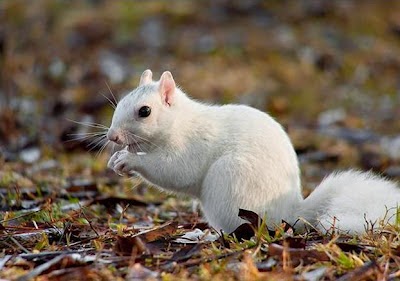
Albino Squirrel

Only 10 in every one million squirrels are born with albinism, and have a very short life expectancy because they are easily seen by both predators and prey due to their obvious lack of camouflage.

What we normally think of when we think of squirrels are tree dwelling gray or reddish mammals. Rarely do we imagine their cousins, the ground squirrels (Prairie dogs) or marmots, even though they are in the same family. Nor do we think of squirrels as white! But, there are many places  that have white or albino squirrel populations.

Most squirrels are gray or red, an adaptation that allows them to blend in to the surrounding vegetation. Tree trunks are usually a dark color and the mottled gray color of the common forest squirrels. However, several towns across america have claimed to have a large population of white squirrels. How could this be if it is advantageous to blend in with the tree trunks to hide from predators?

This is a case of classic natural selection, the driving force behind evolutionary change. Evolution by definition is the changing of the genetic makeup of a population over time. The trait for being white is a genetic anomalie that is usually weeded out because they are so quickly seen by predators. But today we have a different predator: humans.

Many towns have proclaimed to be the "Home of the White Squirrels," and as a result have started trapping and removing their darker brothers and sisters. What a great example of natural selection that has quickly created a dominant squirrel population that is white.

However, there are other places around the country where white squirrels are popping up and it may not be a result of humans trapping the squirrels. Many places have white stone and white buildings of which white squirrels would be highly adapted too. This small advantage may allow white squirrel populations to spread.

Friday, October 24, 2014

Help Honey Bees Survive This Winter

Honeybees are far and away the most important pollinator in today’s agricultural landscape. They pollinate more than 400 crops worldwide, help to create about a third of the food we eat, and contribute an estimated $12 billion to our nation’s food supply.
 All summer long, worker bees can be seen buzzing between flowers, collecting pollen and nectar and, in the process, pollinating vast tracts of crops (upon which we depend) and producing an abundance of honey (some of which is ferried away by beekeepers to local markets for us to enjoy). As summer draws to a close and the weather starts to cool, one of the questions I get a lot is, “What happens to bees in the winter?”

 People often guess that honeybees hibernate; others presume that colonies die as cold weather approaches. Fall’s first frost does kill most members of bumblebee and yellow jacket colonies, leaving lonesome queens to establish new nests each spring.

But honeybees are different.
They’ve evolved a strategy for winter survival that is unique, one that relies heavily on frenzied visitation to flowers throughout the summer and a Herculean group effort in the months beyond. Believe it or not, their success in this endeavor depends on choices that you make for your yard and garden.
Honeybees need their calorie-rich, carbohydrate-loaded honey to keep them alive during the winter; it’s the perfect furnace oil for colonies. Worker bees eat this liquid gold and use the energy it provides to fuel rapid contraction of their wing muscles. Pumping these muscles without flying produces heat in the same way that shivering helps us to warm our own bodies.

As temperatures drop, honeybees cluster together within their hive to share the warmth that their honeybees to keep the inside of their home virtually tropical while the rest of the natural world remains frozen beyond the hive’s walls.
“shivering” generates (picture a ball of bees a foot in diameter and sliced through by sheets of honeycomb). At the core of this cluster, worker bees keep themselves and their queen at a temperature that is only a few degrees lower than that of a healthy human. The cluster’s outer layer consists of tightly packed, slightly cooler workers that insulate the core as effectively as bird feathers or mammalian fur—don’t worry, everyone gets to rotate. This remarkable group behavior allows
Here’s where we come in. Honeybees in temperate climates have only a limited window—about 60 days in total—to stockpile the food reserves that they will live off for the rest of the year. This means that we need to do everything we can to create an environment that lets bees succeed as pollinators when the going is good. Here are three ways you can help bees survive winter:

Plant late bloomers. When it comes to enhancing your garden’s fall bloom, consider adding late-flowering plants like goldenrod and asters that are critical to a colony’s final push to bring home food for the winter.

Avoid systemic pesticides. Certain pesticides have toxins that invade all plant tissues (instead of just living on the plants’ surface), and bees bring these chemicals to their nests when they collect nectar and pollen. A group of chemicals called nitroguanidine/neonicotinoids has been shown to contribute to colony collapse disorder.

Encourage early-spring blooms. Spring brings welcome relief for honeybees with a chance to restock dwindling floral supplies. Flowering trees—willows, maples, and the like—provide some of the earliest opportunities for bees to forage, so try to encourage their toxin-free growth when you can.